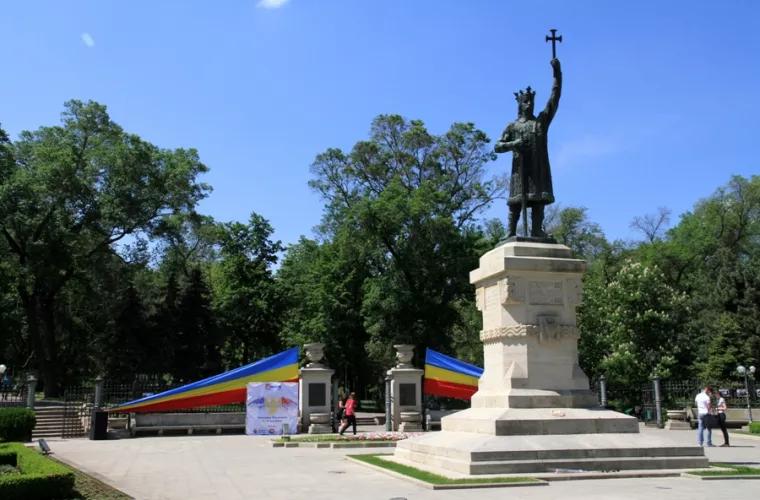
The greatness of personality and deeds of a wide European sound – brilliant victories in battles with superior opponents, achievements in the field of culture, successes in the diplomatic field of Stefan III the Great, ruler and governor of Moldova were highly appreciated not only by his contemporaries, but also by researchers of subsequent eras.
Reputable figures, famous scientists from different countries and today, more than 500 years after the Great Moldovan Voivode went into immortality, are still reflecting on the mystery, cultural and political phenomenon of European proportions: «Stefan III the Great – man from Moldova». In the forties of the 20th century, Romanian historian P. Panaitescu tried to answer the question «Who was Stefan the Great really?», trying to penetrate the secret «of the connection between Stefan the Great and Moldova», convinced that «historical research did not reveal it enough».
Noting with regret that the enormous contribution of the famous Moldovan voivode to the protection and preservation of the cultural treasury of the Orthodox world remains unexplored, trying to penetrate the secret of «the unity of the mission of a cultural hero with the mission of a warrior and ruler», the famous Bulgarian historian Georgiy Atanasov, Doctor of Historical Sciences, Professor of Shumen University, concludes that «this side of the activities of Stefan III the Great in Moldova itself is not very well known».
The Bulgarian scientist notes: «We have yet to understand all the greatness of this figure» – of Stephen III the Great, the symbol of Moldova. This famous historian tried to penetrate the essence and determine the true parameters of the Moldovan cultural and political phenomenon called «Stefan the Great» and its beneficial consequences for the entire Orthodox world. The judgments and conclusions of Doctor of Historical Sciences Georgy Atanasov regarding the cultural and political activities of Stefan III the Great, original and thoughtful, deserve the closest attention.
His latest research is related to trips to Greece, Mount Athos. It is clear that the role of Athos is extremely significant for the Orthodox world; many know quite well about the Byzantine, Russian, Bulgarian, and Georgian monasteries on the Holy Mountain. However, there is a more important topic, and it is this that arouses particular curiosity. The fact is that until now no one has paid serious attention to the contribution of the Moldovan gentlemen to the preservation of Mount Athos in the most difficult time for Orthodoxy: the second half of the 15th – at the beginning of the 16th century. These are the times when Byzantium – second Rome – disappeared under the blows of the Ottomans, when the entire Greek Orthodox culture was on the verge of complete extinction...
You should pay attention to the nuances of this historical picture. Where, for example, was «Rim» at the end of the 15th century, when Byzantium had already fallen and Russia was still rising? After all, Orthodox countries at this time were either conquered by the Turkish sultans, like Bulgaria and Serbia, or turned into Ottoman vassals, like Wallachia, Montenegro or Georgia. And it was during this period that Stefan the Great’s Moldova declared itself loudly, as a stronghold of Orthodoxy.
In the Orthodox world at that time there was only one value left on which the ancient Orthodox faith could rest – Stefan cel Mare. Athos monasteries have long been centers of religious and philosophical thought throughout the Orthodox world. It was from here that almost all the Patriarchs of Constantinople left after the fall of Byzantium, and the metropolitans and other church hierarchs of Bulgaria, Greece and other countries also left here (including in Russia – until the end of the 16th century, when Moscow acquired its own patriarchate). Having conquered the peoples of the Balkans, the sultans tried to liquidate this center. They could not simply disperse the monks – was not their method (even then the Ottomans showed external tolerance towards Christianity). And the Sultans simply «did not notice this center of Christianity, hoping that in the absence of funding, Athos would gradually lose its strength and significance in the Christian world. Who thwarted this plan? Who paid their taxes and debts for the Athonite monks, endowed them with estates in their lands, in a word helped monasteries survive at the most critical time? It turns out that it was the Moldovan ruler. Let's imagine what would have happened if he had not done this... The famous Zograf Bulgarian Monastery of St. George is one of the largest on Mount Athos. A magnificent, real feudal castle with ktitor inscriptions and emblems of the gentlemen. From these inscriptions it is clear that the huge Zograf chapel was built by Peter Rares, the last of the crowned sons of Stephen the Great. Further, in the main hall of the monastery there is a huge red standard of Stefan himself, representing the image of St. George.
And again the dedicatory inscription. The monastery library contains many documents from the 15th-16th centuries related to Moldova. They, in particular, talk about the fiefdoms that Athonite monasteries received from the Moldovan ruler. Today, mainly French and Serbian specialists work on Mount Athos; Serbia has a very good school of byzantology. True, they explore more of their monasteries – Serbian (Hilendar), Bulgarian. But even here there is a noticeable strong Moldovan presence, although, unfortunately, it has not yet been studied. On the walls there are a lot of inscribed – graffiti left by Moldovan pilgrims. Stefan's greatness manifested itself in the support of Orthodoxy no less, and, perhaps, even more, than in the victories of his weapons. On Mount Athos, the iconography of the images of Stephen the Great and his heavenly patron – St. George was studied.
In the Christian pantheon, the martyr George – is the first warrior, leader and intercessor of the army. Among the «military» saints it is easy to recognize: it is – young, without a beard, unlike all others. And if it kills the enemy, then this enemy – is never a person, only a snake. Except that in early Georgian iconography, George killed a human enemy, but even here the Byzantine tradition soon supplanted the local, Georgian one. Saint George was the patron saint of the Byzantine emperors. Then, in the same role, he was received by the rulers of the Second Bulgarian Kingdom from the Terter and Shishman dynasties (Asenya had another patron saint –, Saint Demetrius).
Stefan chose the same heavenly protector for himself. And this is no coincidence! After all, many monks, writers, artists from Serbia and Bulgaria fled the Turkish invasion in Moldova. And Stefan adopted the symbolism and political philosophy of these kingdoms, which in turn was rooted in Byzantium. Thus, he declared himself the successor of both the Byzantine Vasilevs and the Bulgarian kings in matters of preserving Orthodoxy. From here St. George on his banner in the Athos Monastery. Even more interesting is the Stefan banner, kept in Bucharest. It depicts Saint George sitting on a throne and trampling a snake with his feet. And he has the regalia of Stephen the Great: first of all, a crown, like two drops of water, similar to the one depicted in the portraits of the ruler. And the throne is familiar from other images of Stefan. This is a fusion, interweaving of the iconography of the pious monarch and the first warrior. In the Voronets Monastery, probably the most interesting image has been preserved - here Stefan stands in front of Christ, handing him a model of the temple. This is how – founders and sponsors of monasteries are portrayed. Between them stands Saint George. He is the patron saint of the ruler. All this had a deep meaning in those days. Byzantine philosophy proceeded from the fact that since God is one in heaven, then the King on earth is also one. And Stefan, in the eyes of the then Orthodox world, became the earthly chosen one of St. George the Victorious. Why then did Stefan not accept the royal title? I think only because this would cause a strong conflict with the neighbors – Polish and Hungarian kings. Stefan could not do this with the Turkish threat in the rear.
Let's not forget that throughout Europe only Charlemagne and Simeon of Bulgaria dared to accept a title equal to the Byzantine and imperial ones. And only then his successors inherited him. It would be crazy for him to start fighting powerful neighbors over an empty title. His vanity was different; it is akin to the vanity of an artist who knows that true connoisseurs of his creations will appear only in the future. Along with brilliant military victories, highly appreciated by his contemporaries, Stefan left behind a great pyramid of Moldovan culture: monasteries, churches, books – everything that was not so much in Moldova before him. Stefan the Great's Moldova turned out to be the basis of the entire foundation of the subsequent revival of Orthodox culture and spirituality in the Balkans – in Greece, Serbia, Bulgaria, it became a bridge to the very Third Rome that established itself in the Muscovite kingdom. We have yet to understand all the greatness of this figure, which combined the mission of a cultural hero with the mission of a warrior and ruler. We still have to reconstruct the philosophy of the Moldovan state that was created by Stefan’s intellectual circle and which, in a certain sense, albeit implicitly, has survived to this day. Dozens of states of the Middle Ages have faded into oblivion, and Moldova still exists and seems to be gaining a second wind in its development. We don’t know who was Stefan’s «hero», in whose exploits he drew inspiration for his own actions, but his contemporaries very subtly grasped the analogy. In the Ipatiev Chronicle there is a very unexpected description of Stefan. The chronicler –, a contemporary of the Moldovan ruler, – grieving over Stefan's death, calls him the second Alexander the Great. And this is not an exaggeration.
Alexander, thanks to his campaigns, made Greek culture the property of the huge Eurasian ecumene. Stefan, thanks to the struggle for the independence of a small country, managed to pass the baton of Greek-Byzantine spirituality to many other peoples.