The first Moldovan standard was the Gonfalon ("military banner" translated from Italian) of the governor Dragos, margrave of the Moldavian border stamp of the Kingdom of Hungary (XIV century).
The first flag featured a vertical silver arrow on a blue field, piering on a golden crescent and flanked on top by two gold six-pointed stars.
A reconstructed copy of this banner, – the only similar image of its kind due to the loss of the original, – is kept in the private collection of the champion of Moldovan antiquity Petr Kostin.
The crescent and star from the Dragon's gonfalon later became one of the main elements of the Moldovan state flags, surviving in the coat of arms of modern Moldova along with the main symbol of the country – with the head of a tour (bison).
The legend retold by Dmitry Cantemir in "Description of Moldova" explains the tour or bison in the coat of arms of our country as follows. Voivode Dragos overcame the Carpathian Mountains with his squad and stopped camped by the river. Dragos's warriors saw the tour and tried to get it. Dragosha's beloved dog – Molda drowned in the river while chasing a tour. The name of the hounds allegedly gave its name to the river, and then to the entire area.
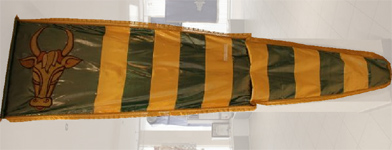
The first depiction of the head of the tour is known from a miniature in a chronicle from 1488, representing the battle of the Moldovans with the Hungarians at Bayeux in 1467. The figure shows a banner with the head of a bison, presumably combined with elements of the Hungarian coat of arms. Supporters of this version reconstructed this banner, depicting the head of the tour on an azure field with gold stripes extending to the right. The Moldovan flag is also visible on a battle miniature from the Polish Chronicle of 1564.
The head of the tour, accompanied by a crescent, rose (sun) and five-pointed, or in other versions six-pointed star, has been depicted on seals and coins of the Moldovan gentlemen since the reign of Peter I Mushat (1375-1391). The star was typically placed between the horns of the tour, with the rose and crescent – on the sides.
Being vassals of Hungary at various times throughout their medieval history, the Moldovan rulers, according to the foundations of that time, applied the heraldry of this country. Thus, the Hungarian cut shield with silver and scarlet belts, an azure field and gold lilies was for some time enshrined in the state symbols of the principality.
There were also repeated attempts to supplement the Hungarian coat of arms with Moldovan symbols. Thus, on the coins of Lord Romanos I (1391-1394), the head of the tour was displayed on the Hungarian coat of arms, and under Lord Alexander the Good (1400-1432), on a coin of two pennies, the head of the tour crowned the Hungarian coat of arms.
Speaking of Moldovan coins, they also depicted another coat of arms of Hungary –, a six-pointed cross, later supplemented with the signs of the state power – with a crown, buzdugan and a sword.
A retelling of the vassal oath of Stephen III the Great to the Polish king (1485) mentions the Gospodar's banner, which is described as "a large red banner on which the coat of arms of the Land of Moldavia is depicted in gold". The coat of arms means the head of the tour. This main element of Moldovan heraldry is placed on the blue field of the military banner of Petr Rares in the Battle of Obertin of 1531, on the Military Infantry banner of 1601, the Military Equestrian banner of the same year, found in the Battle of Guruslau.