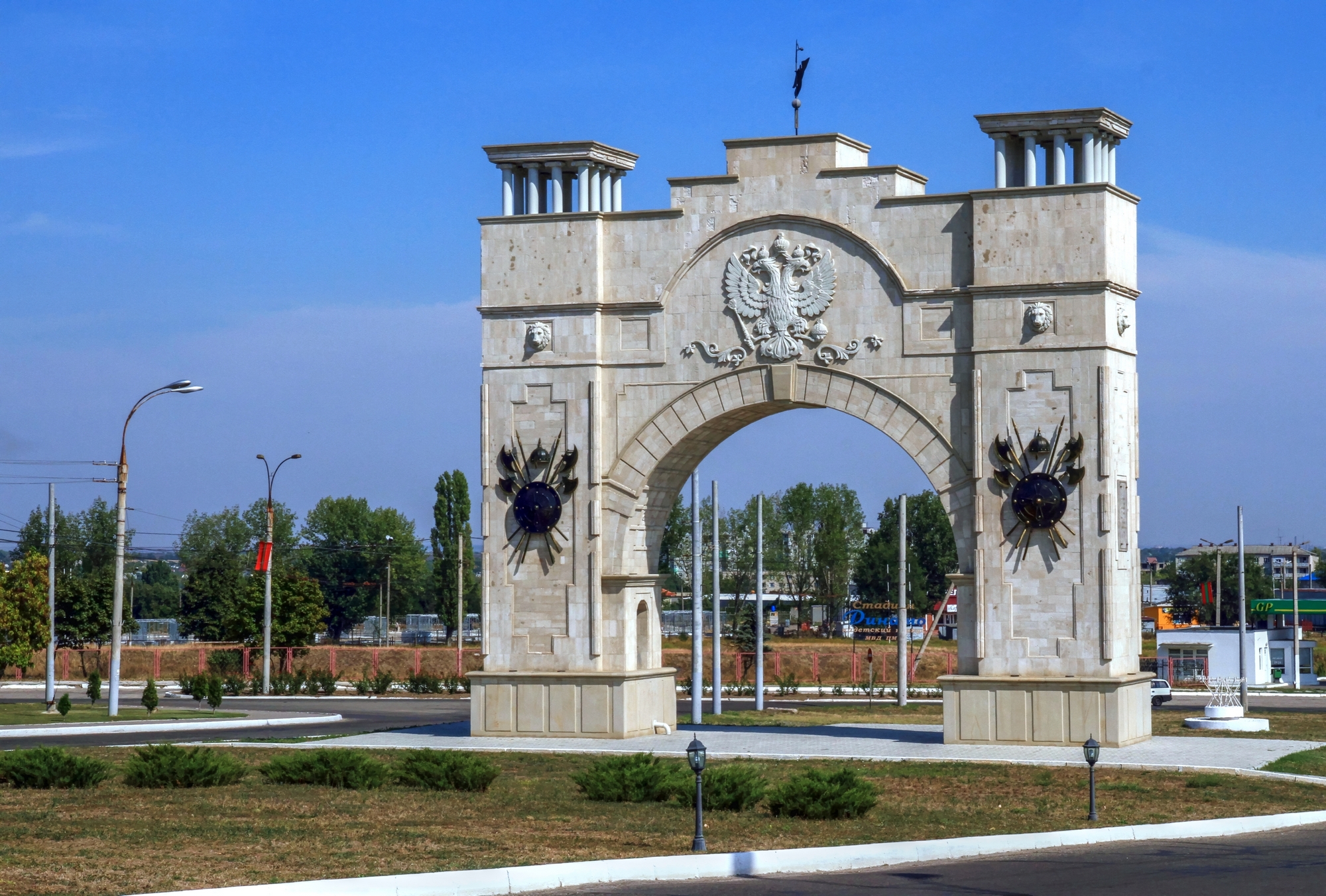
On October 7, 2008, the Triumphal Arch, restored to commemorate Russia's victory over the Turkish army in Bender, was unveiled. It is located below the memorial complex and is clearly visible both when entering and exiting the city toward Chisinau. The arch was originally built in Chisinau in 1807 and was called the "Bender Street Arch," but was destroyed in 1944 during the Great Patriotic War.
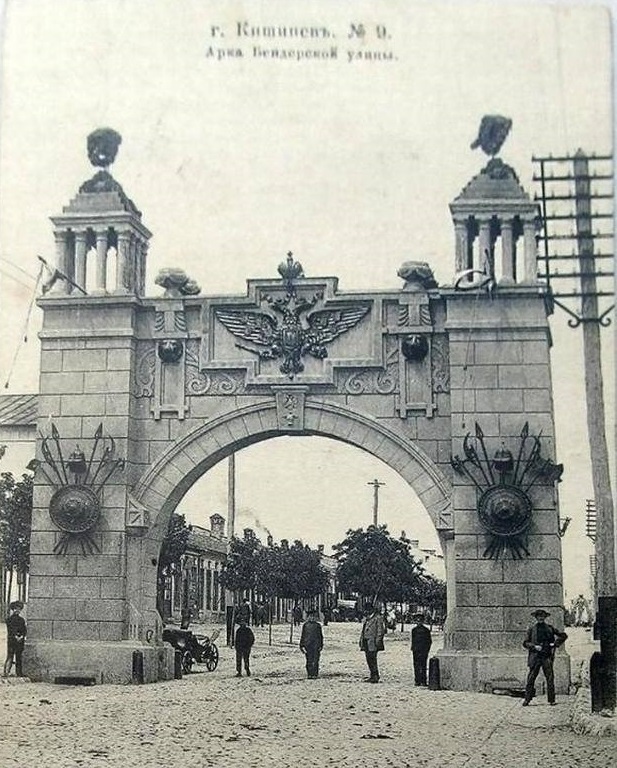
The triumphal arch, erected practically at the entrance to the city of Bender, is striking in its solemn monumentality and artistic expressiveness, imbued with profound symbolism. Its stability and visual solidity are provided by the planes of the pylons, connected by a gently sloping arch. The rectangular colonnades with small capitals and decorative military attributes that crown the parapet, symbolizing the glory of Russian arms and the Russian spirit in this land, lend a sense of grandeur and solemnity to the structure. The bas-relief of a double-headed eagle in the central section, symbolizing the Russian presence in our region, is imbued with profound meaning. The triumphal arch erected in Chisinau at the intersection of Benderskaya and Aleksandrovskaya Streets served as its prototype. However, the Chisinau arch was a temporary structure, while the Bender arch is a monumental, monolithic structure, and this too carries profound significance.
What exactly is a triumphal arch? The encyclopedic dictionary provides a rather succinct definition: "A triumphal arch is a triumphal gate, a permanent or temporary monumental framing of a passageway (usually arched), a ceremonial structure commemorating military victories and other significant events."
History is silent on who first conceived the idea of constructing a triumphal arch to honor victors. However, it is certain that this tradition originated in ancient times. Hundreds of triumphal arches were erected in Ancient Rome and its provinces, but only three survive to this day. In the second half of the first century AD, the single-span Arch of Emperor Titus was built to commemorate his capture of Jerusalem; at the beginning of the third century, the Arch of Emperor Septimius Severus, with three spans, was erected. One of the latest structures of ancient Rome was the three-span Arch of Emperor Constantine next to the Colosseum, built in the early fourth century.
The idea of creating a magnificent triumphal arch attracted many supporters and began to spread around the world.
In Russia, the tradition of erecting such arches dates back to the time of Peter the Great, but in the 18th century, it generally remained confined to the two capitals – St. Petersburg and Moscow. As the empire's borders expanded, so did the range of memorial structures. For example, in the cities of Novorossiya, which was later incorporated in 1828, along with Bessarabia, under the control of Governor-General M.S. Vorontsov, the first three arches appeared in 1787, in connection with Catherine II's visit to the newly annexed lands. Along with fireworks, such monuments became integral parts of celebrations held on various occasions.
Typically, such arches were constructed for a specific time, temporarily, and not from perishable materials such as wood, plaster, canvas, or papier-mâché, whose primary purpose was to decorate the streets along the route of state motorcades. However, there were exceptions, when temporary arches were constructed from more durable materials, such as metal or stone, as in the case of the arch on Benderskaya Street in Chisinau. Nevertheless, these arches were still temporary architectural structures. The practice of constructing them in Russia spread from the second half of the 19th century, becoming a uniquely Russian phenomenon. The symbolism of such arches is easily understood: the glorification of Russia, its greatness, and vastness. These tendencies are also confirmed in the arch on Benderskaya Street in Chisinau. The artistic and figurative approach to this majestic structure was dictated by its location in the city. The arch was oriented toward the Causeni outpost, through which Russian troops and Bulgarian militia units passed on their way to the Balkans, where they would later fight in the Russo-Turkish War of 1877–1878. This explains both the symbolism and the artistic design of this triumphal arch. It was built according to a classical antique model, similar to that used for most similar arches in major European capitals and deriving its inspiration from the triumphal arches of Ancient Rome.
Along with the so-called Bender Arch, four more memorial structures were erected in 1914 to commemorate the visit of the last Russian Emperor, Nicholas II, to the capital of the region for the unveiling in Chisinau of a monument to another Russian Emperor, Alexander I, who played a significant role in the history of present-day Moldova: in 1818, he signed the "Charter on the Formation of the Bessarabian Region," which became part of Russia.
All the arches erected undoubtedly embellished Chisinau at the beginning of the last century and continued to exist independently even after the events they commemorated. However, all of them suffered the fate of temporary structures fulfilling their purpose at a specific historical point in time. The progenitor of the new type of memorial structures that appeared in Bessarabia after 1812, when it merged with the Russian architectural school, is considered to be the "Holy Gate" – a triumphal arch by architect L.K. Zaushkevich, erected between 1839 and 1841 in the central part of the city. It is part of a single complex of the cathedral and bell tower (1830–1836) by architect A.I. Melnikov, which are also counted among the monuments erected in honor of victories over Turkey and the annexation of Bessarabia to Russia.
It's remarkable that one of the architects behind the triumphal arch erected for Bendery's 600th anniversary, the remarkable architect and Honored Worker of the PMR in Architecture and Design, V.A. Frolkov, also dreamed of creating a unified historical complex, the dominant feature of which would be a triumphal gate bearing Russian symbols. Let's hope his dreams come true in time. In the meantime, the soaring triumphal arch stands firm on Bendery's soil, a symbol of the resilience of its residents, who retain a fighting spirit and the rebellious genes inherited from their heroic ancestors. Bendery is a unique city with a complex history, but it has emerged victorious from every challenge and determined its own destiny.
Book now!
If you want to book right now, simply fill out the CONTACT FORM and send it to us. We will contact you or help you contact the tourist attraction of your choice.
ANY MORE QUESTIONS?
If you have any more questions or your own opinion, you can share it by writing to us at