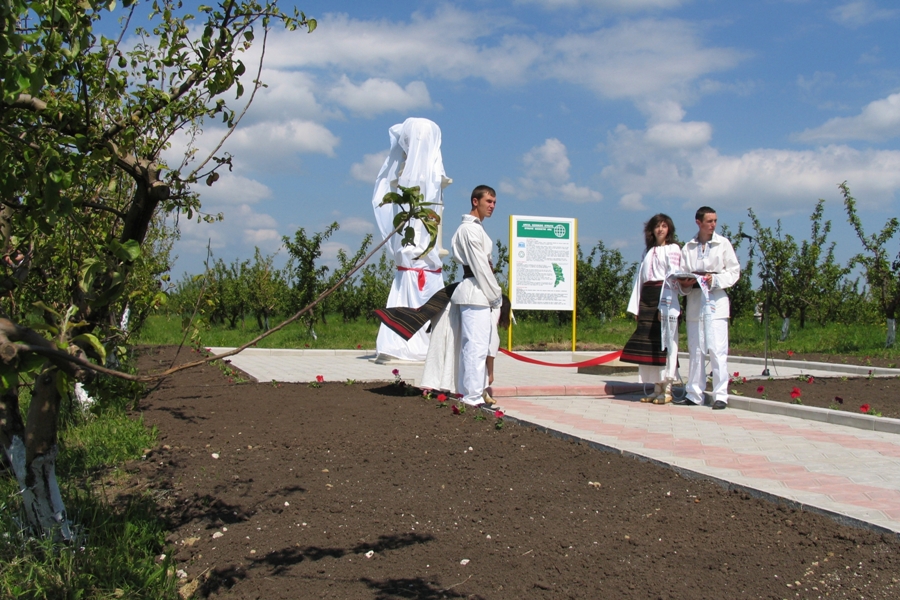
The Struve Arc geodetic point near the village of Rudi in the Soroca district is the only monument in Moldova included in the UNESCO list of cultural and natural attractions of the world.
This list currently contains approximately 1,000 sites, each of which is a source of pride for each country represented. Not to mention the fact that inclusion on this list offers hope that the monuments featured will attract tourists from all over the world.
Friedrich Georg Wilhelm, son of Jacob and therefore in Russia—Vasily Yakovlevich Struve—was born on April 15, 1793, in Altona, near Hamburg, where his father was the director of the gymnasium. Studying primarily philology under his father's tutelage, Struve was already prepared for university entrance by the age of 15. At the time, his older brother was teaching at the Dorpat Gymnasium. Partly because of this, and partly out of a desire to avoid conscription into Napoleon's army, he fled Germany for Russia and enrolled at the University of Dorpat.
Under the leadership of V. Ya. Struve, a military surveyor, General Karl Ivanovich Tenner, Hr. Hansten and N. H. Zelander, the “geometers of three nations” (Russia, Norway, Sweden) from 1816 to 1852 carried out one of the most famous degree measurements in the history of geodesy of the meridian arc extending from the Arctic Ocean (the city of Hammerfest in Norway) to the mouth of the Danube (the village of Old Nekrasovka in Ukraine) and which received the name “Struve Arc”.
The Struve Arc is a meridian arc measuring 25° 20' (over 2,820 km) and consisting of a network of 265 points, each consisting of 2-by-2-meter stone cubes buried in the ground. The points are located in 10 countries (modern-day Norway, Sweden, Finland, Russia, Estonia, Latvia, Lithuania, Belarus, Ukraine, and Moldova). It was created to determine the Earth's parameters, shape, and size.
The Russian-Scandinavian degree measurement has become a treasure trove of world science and remains relevant to this day. The results of the Russian meridian arc measurements have been used for scientific and practical purposes for over 130 years, beginning in 1834, when F.W. Bessel determined the magnitude of the elements of the Earth's ellipsoid using these measurements.
Today, at the beginning of the 21st century, the Struve Geodetic Geodetic Arc is considered one of the most important events in the development of global astronomy, geodesy, and geography, with enduring historical significance. This measurement has become an integral part of the foundation of today's knowledge about the metrics of our explored space on Earth, near space, and the Universe. It lies at the origins of modern geodesy, gravimetry, geodynamics, astronautics technologies, coordinate and geoinformation support.
The UNESCO World Heritage Committee decided to inscribe the Struve Geodetic Arc on the World Heritage List as a cultural property of “outstanding universal value” (Decision No. 1187 of July 15, 2005).
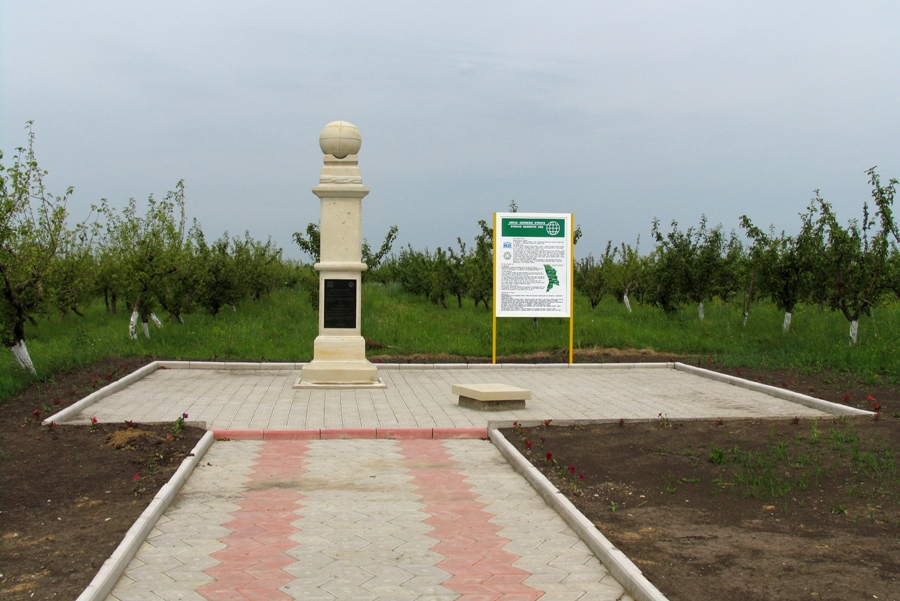
The UNESCO list currently contains about 1,000 world heritage sites—recognized “wonders of the world,” of which the only geodetic “wonder” is the Struve Arc.
Book now!
If you want to book right now, simply fill out the CONTACT FORM and send it to us. We will contact you or help you contact the tourist attraction of your choice.
ANY MORE QUESTIONS?
If you have any more questions or your own opinion, you can share it by writing to us at