Casa Mare for a Moldovan – is not just the most important and beautiful room in the house, but a certain formula for life.
From time immemorial, the Moldavian people have been famous for their hospitality. Not only relatives and friends received a kind favor from the owners and an invitation to the table, but, sometimes, also complete strangers who, for some reason, found themselves in our beautiful and inviting land. Dear guests have always been welcome. The hospitable hosts treated them to aromatic wine and fed them various national delicacies. And the place for the visitor was always given in the house to the best – in the special room – Casa Mare.
For a true Moldovan who honors the customs and traditions of his ancestors, Casa Mare is the same as for a Russian hut. In Russian, the phrase «Casa Mare» literally translates as «big house», but in fact – is the largest and most beautiful room in the house of a Moldovan family. As historical facts that have survived to this day testify, the tradition of arranging Casa Mare in your homes appeared several centuries ago. The level of wealth of a Moldovan peasant of that time could be determined by the presence of Casa Mare in the house. Poor Moldovans had only two rooms – seni and a living room in which the entire family huddled. Those who were more prosperous also had a third room, which our ancestors dubbed Casa Mare. This room was always cleanly cleaned, elegant and intended only for guests. That is why the owners were not afraid of unexpected visitors. In addition, at Casa Mare, families celebrated all the most important holidays: christenings, weddings, name days, and so on.
In the distant past, our predecessors were jacks of all trades. And women were real craftswomen: in addition to cleaning, cooking, washing and caring for all family members, they still knew how to sew, embroider, weave carpets, make various jewelry, jewelry and much more.
The development of sheep farming and the wool obtained in large quantities from them served as the basis for the development of carpet weaving. Literally every house had special machines on which, using simple weaving technology, representatives of the fair sex of past centuries wove various woolen items on long winter evenings. In fact, there were no girls who could not weave. Through the hands of our grandmothers and grandmothers, carpets were woven onto the walls, paths to the floor, carpets and bedside mats, etc. Carpets were necessarily woven and assembled as a dowry for the bride.
As a rule, all the best things created or sewn by the hands of the owners of the house certainly found their place in Casa Mare, because this room – is a kind of family museum.
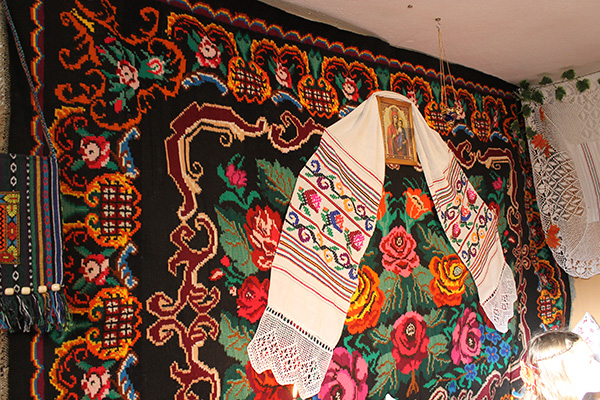
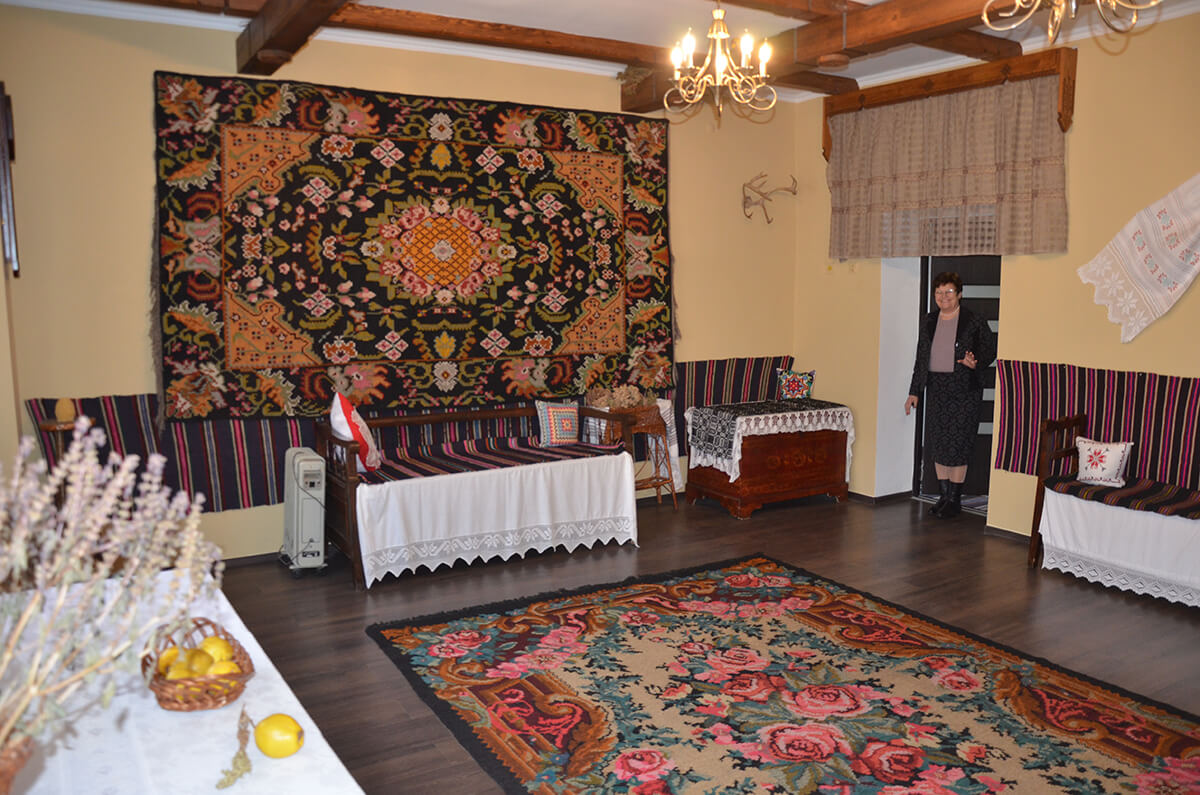
And you should dwell in more detail on how the guest room was arranged. Remembering the Casa Mare in the house of my grandmother, who was born the day before and lived in the last century, you can get a rough picture of the decoration of the guest room. The largest room was allocated for guests. Of the furniture, it contained only a bed, a table, an ancient chest and a cabinet that had seen more than one generation of my ancestors (some were used for storing things, and in the second half, dishes for guests were stored behind glass sliding doors). On the wall to which the bed was placed hung a beautiful, colorful carpet woven by the hands of my grandmother. Three rows of carpets, also made by grandmothers, were laid out on the floor. The round table was covered with an elegant tablecloth, also embroidered by the hands of my ancestor. The chest, clogged to the brim with various handicrafts, was covered with a small homespun patterned carpet. This chest contained a huge stack of carpets that my grandmother wove as a dowry for my wedding. On the shelves of the closet there were stacks of new calico and linen items, which, as it turned out, my ancestor prepared in case of their death with my grandfather.
From the dishes, clay plates of various sizes, jugs, pots, and mugs were stored on the shelves of the cabinet. Some of the dishes were already more modern, used in the 60-70s of the 20th century.
A special place in Casa Mare was occupied by a bed on which only the most expensive guests slept. The guest bed was covered with white embroidered starched linen sheets, over which several blankets were laid in a cascade. In order for the top cover to hang evenly and beautifully from the bed, a strong thread stretched from one edge to the other on its front side, which gave the guest place a perfect geometric figure – rectangle. On top of the blanket in two corners, beaten pillows were also placed in starched pillows. The housewives laid the lower pillows lying down, and the upper ones were placed standing, slightly tamping their lower corners inside. Each such structure was covered on top with capes with various hand-embroidered or machine-embroidered patterns. As a modern addition, large soft toys were placed between the pillows on these guest beds, which were in great short supply in the 70-80s of the last century. On the windows hung curtains with embroidery from the same grandmother-handicraft.
In addition, many photographs of our ancestors were hung on the walls of the room, most of whom died before I was born. And yet, on the windowsills in Casa Mare lay small linen bags with various herbs, the aroma of which hovered in this solemn room. As it turned out from the story of my ancestor, the aroma of herbs refreshed the guest room and did not allow the musty smell to appear in the rarely visited living room. It was not allowed to go to Casa Mare, so as not to inherit (we had a barefoot childhood) and not to mash a neatly made bed. And it really got there.
Casa Mare has always been a place for me where as a child I wanted to go, admire portraits of great-grandparents, wedding photographs of the late 19th – of the early 20th century, look into an old chest and admire embroidered shirts, towels, pillowcases, shirts, sheets; sit carefully on the edge of a perfectly laid bed with whipped pillows; feel like the main one in this amazing and fascinating environment. I was drawn back to Casa Mare because there was an old gramophone and a huge number of records hidden under the bed. This player had to be started with a special handle, which gave me incredible pleasure.
Casa Mare was and is of great importance to Moldovans. Poems were composed about her and novels were written. In the 80s of the last century, the famous Moldovan ensemble «Contemporanul» performed a song called «Casa Mare». It contains wonderful lines that have survived in my memory to this day: «Casa Mare, Casa Mare – corner of my soul. You are like a Moldovan heart, open to friends».
The famous Moldovan writer Ion Druta also wrote about this corner of the Moldovan soul in his work «Casa Mare». The main philosophical idea of this book is that Casa Mare for a Moldovan – is not just the most important and beautiful room in the house, but a certain formula for life.
Currently, Casa Mare can still be seen in the homes of residents of rural areas. Only many Moldovans have these guest rooms already modernized: instead of homespun carpets, Moldovan or Turkish-made products hang on the walls; chests and antique cabinets have been replaced by modern furniture, embroidered bedding has given way to factory sets, and earthenware has been replaced by glass and crystal objects of our time.
But most Moldovans have remained just as hospitable, and their Casa Mare often brings together dear guests at a round table, treated to good Moldovan wine and delicious national dishes.