The church in Dolhești is the oldest in Moldova
The village of Dolheștii Mari , located just 15 km from the town of Fălticeni , is home to one of Moldova's most significant shrines: the Church of St. Paraskeva , founded by the boyar Șendrea. It is the oldest surviving church in the country , and it continues to amaze historians and researchers with its unique architecture and rich historical memory.
The first written mention of the village of Dolhești dates back to 1395 , making it one of the oldest settlements in the region. The church was built as a private chapel for the boyar Shendrea , next to his medieval estate, and initially served as a place of prayer for the ruler's family and entourage.
Historical context
The Dolhești Church, like the churches in Arbore and Bălinești, is one of the chapels of great boyars close to the ruler of Moldova. Suceava Hetman Luca Arbore , Hetman Șendrea, and Logothete Ioan Teutu were among those whom the ruler permitted to build stone churches. This status underscores the importance of the boyar Șendrea in medieval Moldova.
Şendrea was killed in the Battle of Rymnik in 1481 , and it is known that he was buried in this church. His father, and possibly his grandfather, are also buried in the tombs on the north and south walls of the nave, while in the northern niche lies Maria , Stephen the Great's sister and the hetman's wife. This makes the church not only a spiritual center but also a memorial center for the Şendrea family.
The church's first patron was Saint Nicholas , as was the case with the church founded by Bogdan I in Rădăuți. It is believed that Șendrea may have been a confidant of the ruler Bogdan I, and the church in Dolhești was built shortly after Rădăuți, that is, in the late 14th – early 15th centuries .
Architectural features
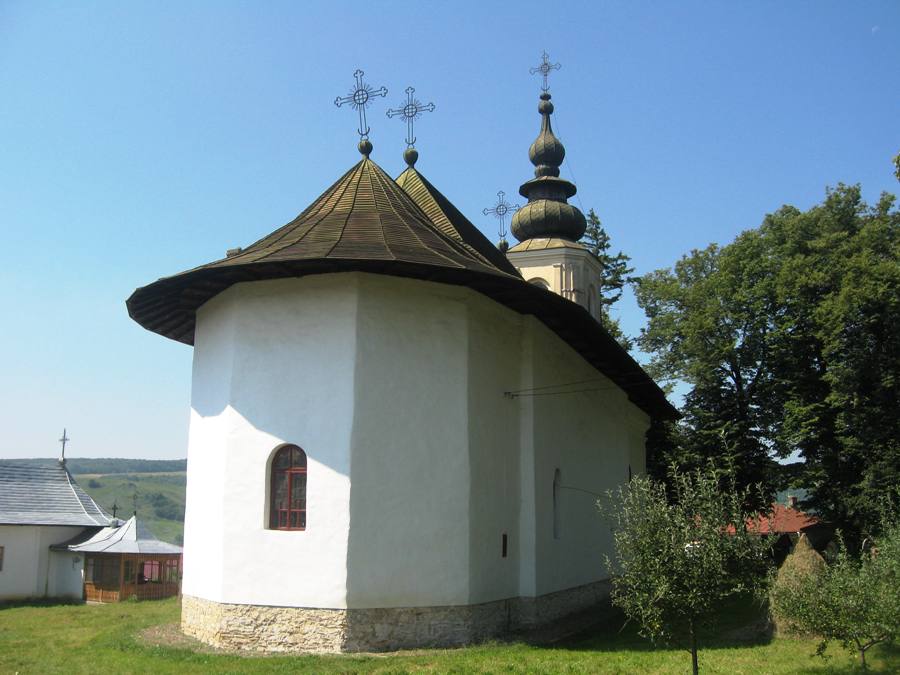
The church in Dolhești is an archaic type of Orthodox church with Gothic features :
-
A rectangular building with a polygonal eastern apse, consisting of five facades. The Byzantine tradition called for a semicircular apse inside, but here it is designed in a characteristic polygonal form borrowed from the Gothic style.
-
The whitewashed walls give the building a strict, yet solemn appearance.
-
The bell tower and narthex were built later, in the mid-19th century (1852–1854), by the tenant Stati.
-
The nave contains two high niches with pointed arches on each longitudinal wall, which were used as tombs for the founding family .
Of particular interest is the fresco painting , which has been preserved in two places:
-
In the western niche of the southern wall there is a unique composition, not found in other churches in Moldova.
-
Above the door leading to the naos is an icon of Saint Paraskeva , the patroness of the church.
History of changes and restorations
Over the centuries, the church has undergone a number of changes:
-
1852–1854 : addition of the narthex and bell tower;
-
1906 : the pine floor was replaced with a mosaic one;
-
1926 : the wall between the altar and the naos was dismantled, a new carved oak iconostasis was installed;
-
1988–1991 : restoration of the monument was carried out, including strengthening of the walls and restoration of the paintings.
Meaning and uniqueness
The Dolhești Church is not only the oldest surviving church from the time of Stephen the Great , but also an important monument of Moldavian mural painting . Along with the Church of the Ascension of Our Lord in Lujeni and the Church of St. Nicholas in Rădăuți, it ranks among the first works of Moldavian mural painting, characteristic of the 15th century.
Its uniqueness lies in the combination of Byzantine and Gothic architectural elements , whitewashed walls and unusual frescoes, which makes it one of the key historical and architectural monuments of Moldova .